Before you book
Fees, permit policies, age requirements and seasonal conditions can change. Confirm current details with Whitan Safaris before paying or finalising travel plans.
Introduction
Choosing between Bwindi Impenetrable National Park in Uganda and Volcanoes National Park in Rwanda usually comes down to one thing: what kind of trek do you actually want? Both parks protect the same endangered gorilla subspecies. Both give you the same regulated one-hour encounter with a habituated family. Past that hour, the trip changes completely: permit price, distance from the airport, forest terrain, how hard you'll hike, and the overall feel of the day.
While they offer the same safari experience, the parks vary in landscape and feel. Bwindi is a dense, ancient rainforest, offering muddy, steep climbs and a real sense of wilderness. Volcanoes trades that for bamboo forest and open volcanic slopes, with easier terrain and a shorter drive from Kigali. One Park costs less and gives you more flexibility. The other costs more but runs smoother, start to finish.
This guide compares the two gorilla trekking bases side by side, to help you make the right decision, based on your preferences.
Understanding the Gorilla Trekking Bases
Location
Bwindi Impenetrable National Park
Bwindi sits in southwestern Uganda. It's a UNESCO World Heritage Site and one of Africa's oldest and most biologically diverse forests, believed to have survived the last Ice Age. The park covers steep, dense Afromontane rainforest, split into four trekking sectors: Buhoma, Ruhija, Rushaga, and Nkuringo. Each sector has its own character, access route, and roster of gorilla families (altogether roughly 19 habituated groups).
Volcanoes National Park
Volcanoes lies in northwestern Rwanda, along the Virunga mountain chain — the same range where primatologist Dian Fossey spent nearly two decades studying the gorillas she helped save from extinction. The landscape is dominated by dormant volcanoes, bamboo forest, and open slopes. Every trek, across all 12 habituated families, starts from a single headquarters near Kinigi. One briefing point, one road in, permits allocated the same morning.
Bwindi vs Volcanoes: Park Landscape (Terrain, Vegetation)
Bwindi
"Bwindi" comes from Mubwindi — a local Runyakitara word meaning "a place of darkness,” and the name fits. The forest is thick, multi-layered, and often described as "impenetrable." Expect steep ridges, deep valleys, dense undergrowth, tangled roots, vines, and frequent mud after rain. Elevations here range from about 1,160 m to 2,607 m, with 60% of the park sitting above 2,000 m. The park’s closed canopy creates a humid, enclosed atmosphere, limiting visibility. Trackers sometimes have to cut fresh paths through the vegetation for visitors. The overall feeling is one of deep wilderness immersion.
Volcanoes
Volcanoes National Park starts higher. The entry point at Kinigi already sits around 2,400 m, and gorilla families are often found between roughly 2,200 m and 3,500 m on the volcanic slopes above. The park’s large areas are covered in bamboo and are more open than Bwindi's mixed rainforest, with clearer ridges and long views over the surrounding peaks. Paths still turn muddy and slippery after heavy rain. But the lower vegetation density makes treks feel less physically enclosing than Bwindi's, even as the altitude adds its own challenge.
Getting There
| Route | Bwindi | Volcanoes |
|---|---|---|
| From Kigali | 4 – 5 hours by road | 2.5 – 3 hours by paved road |
| From Entebbe/Kampala | 8 – 10 hours by road<br> or 1.45-hour flight to Kihihi/Kisoro | N/A |
| Nearest international hub | Kigali (via border) or Entebbe | Kigali International Airport (KIA) |
Bwindi
Reaching Bwindi takes more planning. The road journey from Kampala or Entebbe Airport usually takes 8 – 10 hours, depending on the sector and road conditions. Many travellers find it easier to fly into Kigali and then drive to Bwindi, roughly 4 – 5 hours, using the East African Tourist Visa to cross the border.
Domestic flights from Entebbe to Kihihi or Kisoro are also available, cutting travel to about an hour in the air plus a short road transfer. From the airstrip to the park, it’s about a 1.5 – 2-hour transfer, depending on the sector of your assigned gorilla family.
Volcanoes
Volcanoes is clearly more convenient. The drive from Kigali International Airport to park headquarters at Kinigi takes about 2.5 to 3 hours, on well-maintained, paved roads. Land in Kigali in the morning, and you can reach your lodge by early afternoon, ready to trek the following day. This short transfer is one of the main reasons travellers with limited time choose Rwanda.
Gorilla Families: Bwindi vs Volcanoes
Bwindi
Bwindi has the largest number of habituated mountain gorilla families of any park, roughly 19, spread across four sectors. That means more daily permit capacity, upward of 150 permits a day, and more flexibility when booking. Park authorities here also have more options for matching visitors to families by fitness level.
Popular families include Mubare and Rushegura in Buhoma, Bitukura in Ruhija, Nshongi and Mishaya in Rushaga, and Nkuringo in Nkuringo, to name a few.
Volcanoes
Volcanoes has fewer habituated families open to tourism, typically around 12. That means a lower daily permit ceiling, usually 96 to 98 permits, eight visitors per family per day. Fewer groups, but tighter monitoring, and sightings remain extremely reliable.
Popular families in Volcanoes include Susa, Sabyinyo, Agashya, Amahoro, and Kwitonda.
Bwindi vs Volcanoes: The Gorilla Trekking Experience
Bwindi
Hikes to see the gorillas in Bwindi depend on where the assigned family is that morning — anywhere from under 1 to 6 or more hours. Expect steep climbs, descents into valleys, thick vegetation, and mud. Trackers often leave before dawn to locate the family, while your guide adjusts the route as reports come in. Once the gorillas are found, the one-hour encounter unfolds deep inside the rainforest, often with the group crouched in undergrowth just metres from them.
Bwindi is also the only park offering the Gorilla Habituation Experience — where visitors are allowed up to four hours with a semi-habituated family, alongside researchers and trackers, instead of the standard one hour.
Volcanoes
Treks in Volcanoes typically run 1.5 to 4 hours, through bamboo forest and open moorland rather than dense canopy. That means clearer sightlines and easier photography; unlike in Bwindi. The main physical test is altitude, as some gorilla families range above 3,000 metres, where the air thins noticeably. Along the way, the volcanic peaks of Sabyinyo, Bisoke, and Karisimbi stay visible in the background. Once you reach the family, the one-hour encounter follows the same strict rules as Bwindi.
Gorilla Permits, Booking and Availability
Bwindi
The standard permit for foreign non-residents is $800 per person, $700 for foreign residents, UGX 300,000 for East African nationals, and $500 for the rest of Africa. During the low season (April, May, and November), the price drops to $600. These discounted permits are date-specific and generally non-reschedulable. The Gorilla Habituation Experience costs $1,500, rising to $1,800 from January 1, 2027. Uganda gorilla permits are issued and regulated by the Uganda Wildlife Authority (UWA).
Pro Tip: As of March 2026, travellers are required to pay in full at the time of booking; the old seven-day reservation hold is gone. We still recommend booking several months ahead through a licensed operator, especially for peak-season dates.
Volcanoes
The standard permit for foreign non-residents costs a flat $1,500 year-round. A conditional low-season discount of roughly 30%, which brings the price to about $1,050, runs November through May. But it only applies if you’re also staying in Akagera or Nyungwe Forest National Park.
Lower promotional rates apply for East African citizens and certain categories of African residents under specific conditions set by the Rwanda Development Board (RDB). Daily capacity is tighter than in Bwindi, so popular dates in June – September and December – February can sell out early. Booking through a licensed operator or the official RDB channels is essential.
Bwindi vs Volcanoes: Rules, Regulations and Physical Demands
• Core rules are nearly identical in both parks;
• Minimum age to trek is 15.
• Group size is capped at 8 visitors per gorilla family.
• The encounter with a family is strictly one hour, with no flash photography and a minimum 7-metre distance.
• Don't trek if you're showing any signs of illness — gorillas share close to 98% of human DNA, which makes them just as vulnerable to our illnesses as we are to theirs.
• Both parks provide armed rangers and experienced trackers.
Bwindi vs Volcanoes: Physical Demands
Bwindi
Bwindi’s steep terrain, dense vegetation, and variable trek lengths make it a more physically demanding option for most visitors. A reasonable level of fitness and sure-footedness helps.
Porters are also available at the trailhead and strongly recommended. Hiring one isn't just about easing your own climb; it's income that flows straight back into surrounding communities.
Volcanoes
Starting at 2,400 metres, some visitors feel it fast — shortness of breath, a heavier pace, even on clear, open paths. Families that range higher, like Susa on the slopes of Karisimbi, push well past 3,000 metres and turn a moderate hike into a demanding one. Porters are available and widely used here too. In most cases, park staff also try to match each group to a family that fits their stated fitness level, decided the morning of the trek.
Bwindi vs Volcanoes: Accommodation Options
Bwindi
Accommodation in Bwindi Impenetrable Forest National Park ranges widely, from simple community-run camps to comfortable mid-range lodges to high-end properties with excellent forest views. This variety makes Bwindi accessible across different budgets, without sacrificing quality for travellers who want more comfort.
Volcanoes
The lodge selection in Volcanoes, however, leans more toward mid-to-luxury. Properties like Bisate Lodge, Singita Kwitonda, and One&Only Gorilla's Nest sit within minutes of the park gate, built around design, service, and dramatic volcano views. Many properties emphasise design, service, and dramatic views of the volcanic peaks. While mid-range options exist, the overall product is more premium in character and pricing.
Best Time for Gorilla Trekking
Both parks operate gorilla trekking year-round. Permits aren't weather-dependent. The driest, most popular periods are June to September and December to February, when trails are generally in better shape. Demand for permits peaks then too, so book early.
The wetter months (particularly April, May, and November) bring more rain, muddier trails, and fewer visitors. In Uganda, these same months currently offer the reduced $600 permit rate. Many experienced travellers consider these low/shoulder months and green seasons excellent times to trek if they are prepared for wetter conditions.
Beyond Gorilla Trekking
Bwindi
Beyond gorilla trekking, Bwindi offers forest walks, birdwatching (over 350 recorded species), and cultural visits with the Batwa community. Visitors can also combine Bwindi with nearby parks like Queen Elizabeth National Park, home to the tree-climbing lions, or Lake Mburo for a shorter game drive add-on.
Volcanoes
Volcanoes offers golden monkey tracking, the hike to Dian Fossey's grave, and the Mount Bisoke crater climb. Visitors can also combine Volcanoes with Akagera National Park for a Big Five safari, Lake Kivu for a slower finish, or a day in Kigali itself.
What Can I Expect on a Gorilla Trekking Experience in Bwindi and Volcanoes National Park?
Before the Trek
Both parks begin the day with an early briefing (usually between 7:00 and 8:00). Rangers explain the rules, introduce the tracking team, and allocate a gorilla family based on the size and fitness of the visitor group. Porters are available for hire at this point, at $15 – $20 per person. You will be asked about your fitness level so you’re assigned a suitable family.
During the Trek
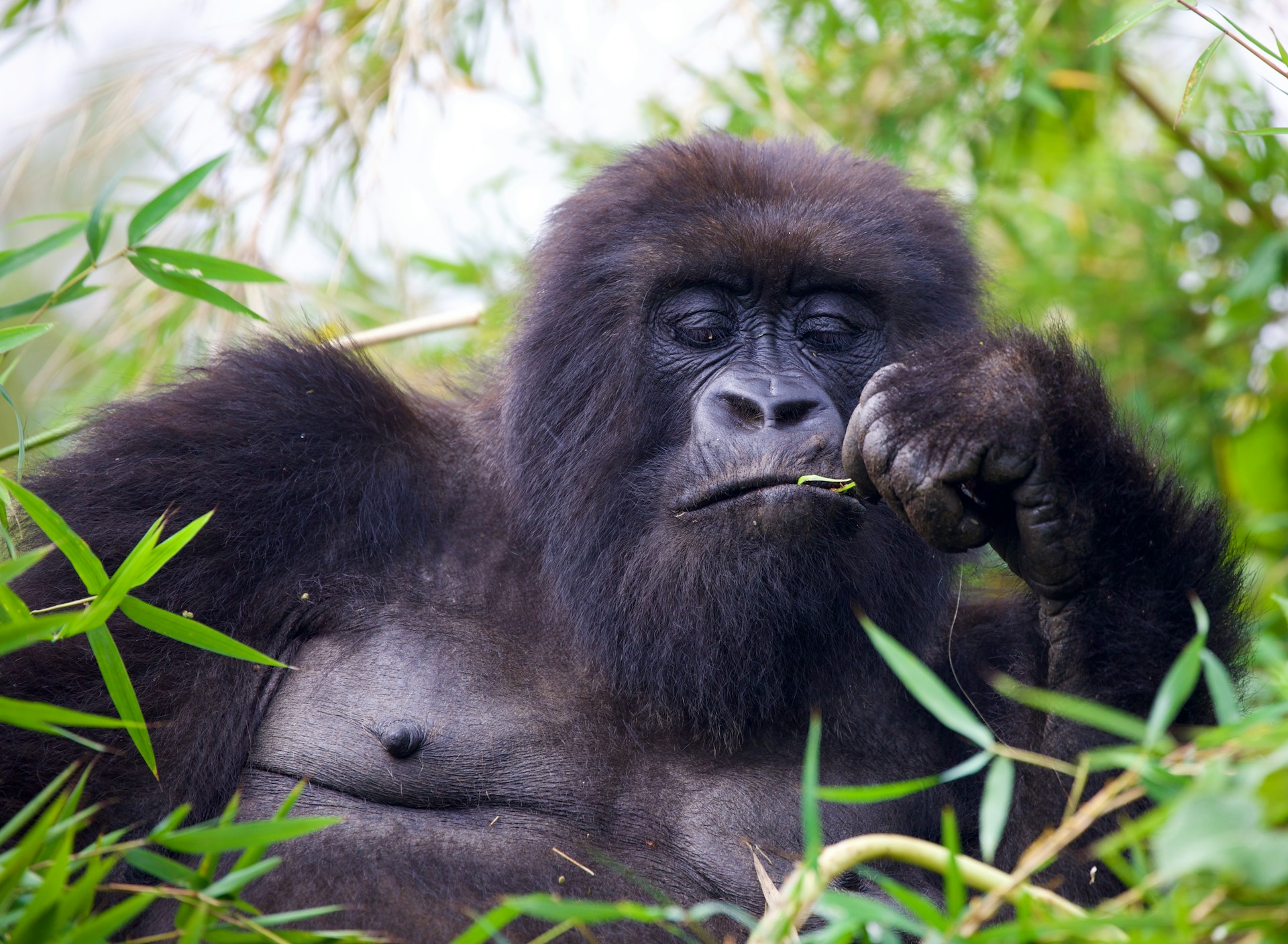
You walk with rangers and trackers through the forest until the gorilla family is located. Walking time varies from under an hour to several hours depending on the location of your group that day. Once the gorillas are found, the clock starts on the regulated one-hour encounter. Guides manage the group carefully to keep disturbance low and the experience safe. You may observe feeding, resting, playing, or the silverback’s presence.
After the Trek
You return to the trailhead, often receive a certificate of trekking, and transfer back to your lodge. Most people spend the rest of the day resting, sorting photographs, and absorbing the experience. The emotional impact of the encounter frequently stays with visitors long after the trek ends.
FAQs
Which Park is better for first-time gorilla trekkers?
Both work well. Volcanoes suits travellers with limited time and who seek easier terrain; Bwindi suits a wilder trek at a lower price.
How much do gorilla permits cost in 2026?
Bwindi: $800 in high season, $600 in low season (April, May, November).
Volcanoes: a flat $1,500, or roughly $1,050 if paired with Akagera or Nyungwe.
Is the gorilla trekking difficult?
Moderate to demanding, depending on the family and weather. Bwindi tests you with steep, muddy terrain; Volcanoes tests your lungs with altitude.
Can I visit both Bwindi and Volcanoes on the same trip?
Yes. Trek one park, then cross the border via Cyanika or Katuna to trek the other. Just budget for extra road time and a second permit fee.
How far in advance should I book permits?
At least 3 to 6 months out for peak season (June–September, December–February). Book earlier for the Habituation Experience.
What is the main difference in the actual gorilla encounter?
Not much. Both parks give you the same regulated one hour with a habituated family — the real difference is the journey to get there.
Is gorilla sighting success guaranteed?
No — these are wild animals, so nothing is guaranteed. But daily tracking keeps success rates very high in both parks.
Conclusion
The right choice between Bwindi and Volcanoes National Park comes down to your budget, your time, your fitness, and whether you want a wilder forest adventure or a more accessible, scenic trek. Once you decide, book your permits early. Prepare for the physical demands of the day. And let the encounter itself be the highlight. Either park can deliver one of the most memorable wildlife experiences in Africa.
Plan your journey with a local expert
Speak with the Whitan team about your plans and get personal advice for your trip.